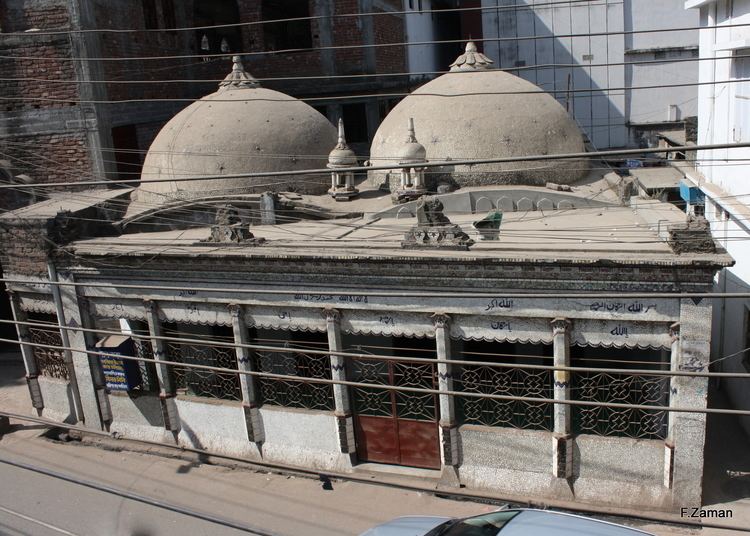
Binat Bibi Masjid is the earliest dated Islamic structure in Dhaka and one of the few intact 15th-century mosques across the wider Bengal region. Modest in scale but unusually rich in documentary evidence, it functions today both as a living place of prayer and as a primary source — a piece of medieval Bengal still in service.
Most monumental mosques of the Bengal Sultanate carry the name of the ruling sultan or his governor. Binat Bibi Masjid is a deliberate exception. Its founding inscription identifies the patron as Bakht Binat, daughter of Marhamat — a private citizen, almost certainly a woman of considerable means, whose endowment outlived the empire that authorised it. In a documentary record dominated by sovereigns, the mosque preserves a feminine voice in Bengal's Islamic past.
The phrase “Binat Bibi” is itself a layered title: binat meaning “daughter of” in Arabic, bibi a Persian honorific for a respected lady. The mosque's very name is a small linguistic record of the cosmopolitan vocabulary of medieval Dhaka.
“To name a mosque after a daughter is to defy the grammar of medieval power. The dome is hers; so is the silence beneath it.”
Narinda lies on the southern edge of historic Dhaka, between the Buriganga's older bend and the city's mediaeval grain markets. In the mid-1400s — a century before Dhaka rose as Mughal capital of the province — Narinda was already a settled riverine quarter, frequented by merchants, sufi travellers and scholars moving between Sonargaon, Pandua and the Hooghly delta. The mosque's location is therefore not an afterthought but a marker: it tells us where the Muslim community of pre-Mughal Dhaka actually gathered.
What separates Binat Bibi Masjid from comparable sultanate-era ruins is its function. The mosque has not been excavated, reconstructed and re-presented to visitors as a museum object. It has, instead, simply continued. The five daily prayers have been observed here, with negligible interruption, for more than five and a half centuries. Conservation, when it has come, has had to negotiate with use — replacing where unavoidable, retaining where possible, and accepting the patina that comes of being prayed in by hundreds of generations.
This makes the building a rare hybrid: a primary archaeological source which is also still, in the technical sense, occupied. The mihrab is not behind glass. The threshold is worn by feet that crossed it yesterday.