Binat Bibi Masjid is significant not because it is old — many things in Old Dhaka are old — but because it has remained doing the thing it was built to do, in the same place, in the same direction, for more than five centuries. Few human institutions, of any kind, can make that claim.
Islam arrived in Bengal not as conquest alone but as a slow accretion of merchants, sufi teachers, soldiers and scholars travelling from Persia, Central Asia and the Arab world. By the time Bakht Binat commissioned her mosque in 1457, that arrival had already settled into something distinctly Bengali. The faith spoke Arabic in its prayers, Persian in its inscriptions, and Bengali in its everyday relations with the city. The mosque is the architectural expression of that triple register.
Significance, here, is therefore neither purely religious nor purely cultural. It lies in the demonstration that those two categories — religion and culture — are not separable in the architecture of a working community. The same building that hosts Friday prayer also hosts the marriage announcements, the funeral biers, the seasonal donations of rice and dates, and the quiet midnight prayers of insomniac neighbours. It is an instrument of belief; it is also an instrument of living.
“For five centuries, the same call has woken the same lane. The mosque is the lane's longest-serving citizen.”
A second layer of significance is symbolic. As the earliest dated Islamic structure in Dhaka, the mosque functions as a kind of foundational citation in the city's Muslim self-understanding. School visits, heritage walks, ramadan night-walks, eid processions — all converge here at some point in their cycles. It is a quiet anchor in a city which, since 1971, has actively rebuilt its sense of itself; the mosque pre-dates that rebuilding by half a thousand years, and quietly authorises it.
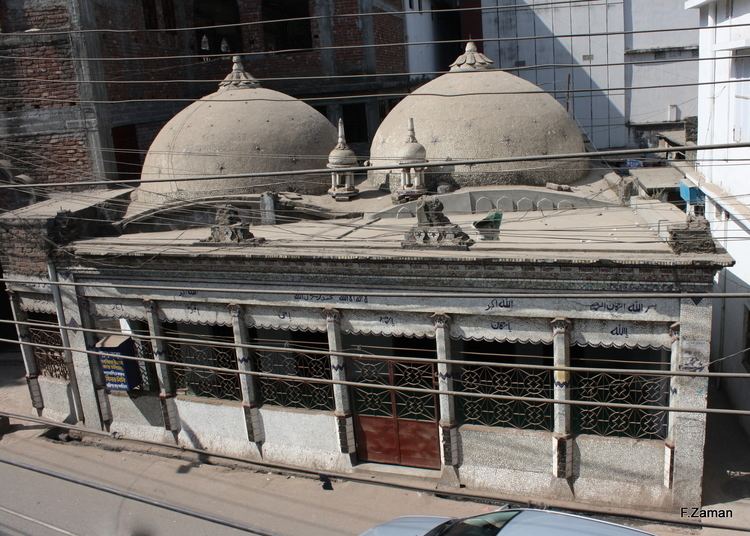
Fajr, Dhuhr, Asr, Maghrib, Isha — observed without interruption since 1457. The morning prayer at first light is the longest unbroken devotional act associated with this site.
The Friday gathering swells beyond the original chamber, spilling into the later annexes and onto reed mats laid in the courtyard. The prayer is the same; the building has grown around it.
Through the month of Ramadan the lane around the mosque becomes a working iftar street. Eid prayers begin before sunrise, with worshippers arriving in white from across Narinda — a once-a-year reading, in fabric, of the neighbourhood the mosque has organised.
The mosque administers a small but continuous waqf (religious endowment), supporting maintenance, the imam's stipend, and modest charity to neighbouring families during Ramadan and on death anniversaries of the founding family.
A small maktab teaches Qur'anic recitation to children of the surrounding lanes — the educational function the mosque has performed, in different forms, for centuries. The chamber that once heard the patron's mother-tongue still teaches it.
Each year, before the monsoon, neighbourhood volunteers gather to clear gutters, repaint the woodwork and lime-wash the boundary wall. This is not formal conservation. It is something older: the local custody that has, in fact, kept the mosque standing.