Home Architecture & Design
A Building, Read Carefully

A modest plan that became a regional grammar.

Binat Bibi Masjid is small. Its prayer chamber barely exceeds nine metres on a side. But almost every architectural feature it carries — the single dome, the recessed mihrab, the chamfered piers, the engaged corner turrets — would be repeated, scaled and elaborated across two centuries of Bengal mosque-building. To understand it is to understand a vocabulary.

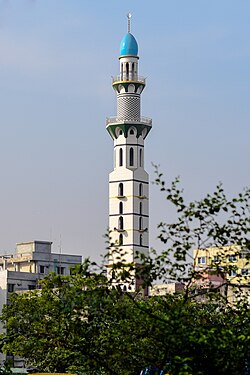
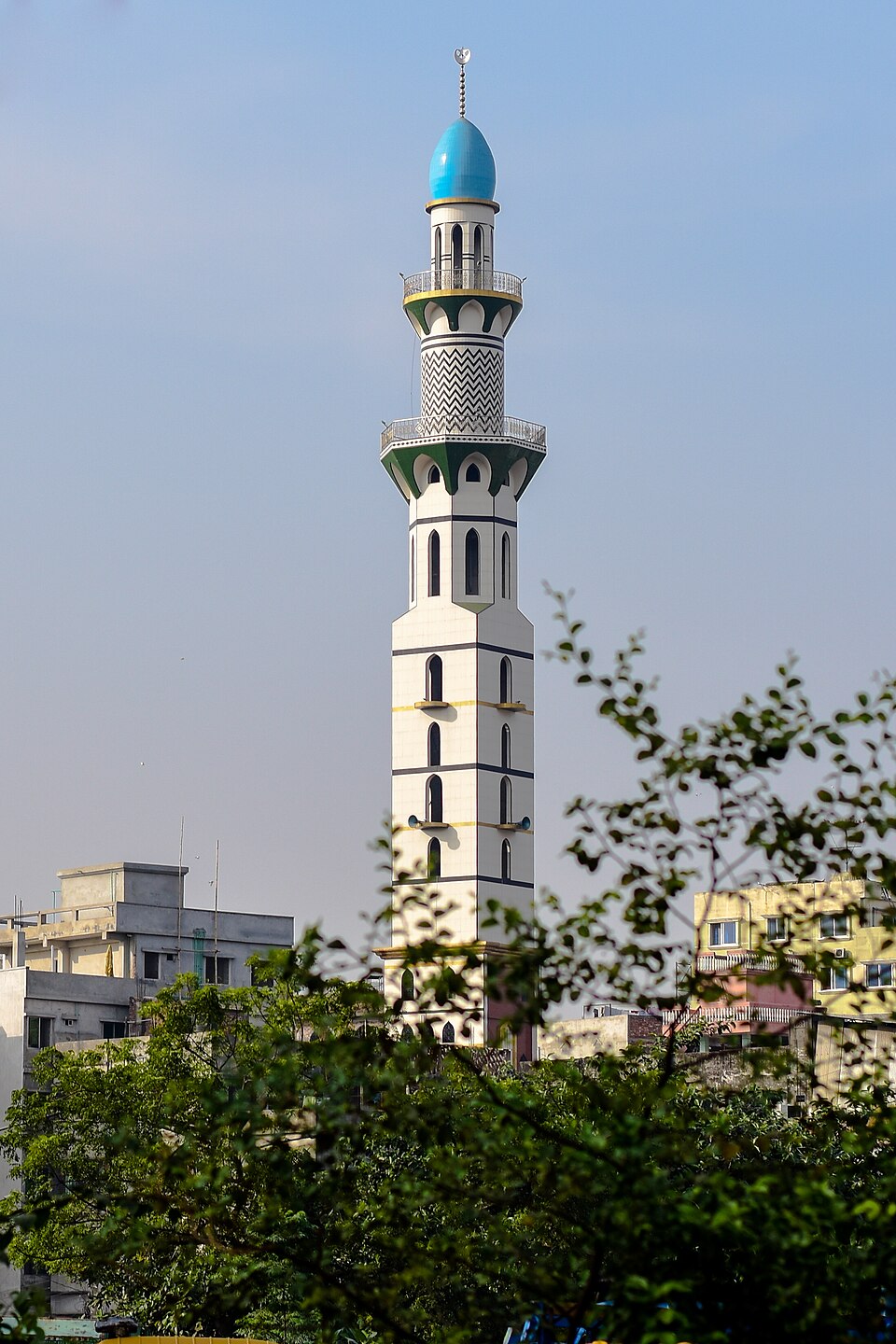
The blue minaret of Binat Bibi Masjid
The blue-tiled minaret — added in a later century, but built in continuity with the original idiom.
Component by Component

Eight elements that compose the mosque — and locate it inside Indo-Islamic architectural history.

The Single Dome

A hemispherical dome rises on an octagonal drum, supported internally by squinches that translate the square chamber into eight, then sixteen, then a circle. This dome-on-square-chamber type — first crystallised in 14th-century Bengal — becomes the dominant mosque form of the delta, and Binat Bibi Masjid is among its earliest dated survivors.

The Mihrab

The central recess in the qibla (western) wall, indicating the direction of Mecca. Binat Bibi's mihrab is a deep arched niche, framed by engaged colonettes and a multi-cusped arch. Above it sits the founding inscription tablet — placing patron, sultan and date directly into the architectural axis of prayer.

Engaged Corner Turrets

Each external corner of the prayer chamber is bound by a slender, engaged turret rising in cylindrical sections, banded by mouldings. They are not minarets in the functional sense — the call to prayer is not made from them — but they perform a visual job, locking the cuboidal mass of the chamber into a stable rectangle and articulating its corners against the horizon.

The Multi-Cusped Arch

Doorways and the mihrab itself use cusped arches — a profile of small, repeated lobes that gives the opening its lace-like edge. This profile travels into Bengal from the architecture of the western Delhi Sultanate; here, it is rendered in moulded brick rather than stone, and so reads softer, deeper, more shadowed.

The Curved Cornice

The roofline of the chamber rises into a gentle curve at its parapet — a line that quotes, in baked brick, the bamboo-and-thatch huts of the Bengali countryside. This is one of the most distinctive contributions of Bengal architecture to the wider Indo-Islamic tradition: it would be exported, two centuries later, into the Mughal monuments of Lahore and Agra as the chau-chala line.

The Brick Module

The mosque is built almost entirely of small, thin, dense baked bricks — a module particular to medieval Bengal, where stone is scarce and clay is abundant. The bricks are laid in lime mortar, with deep, sharply struck joints that throw shadow lines across the wall and animate it through the day.

The Later Minaret

The slender blue-tiled minaret that today rises beside the mosque is not original to the 1457 fabric. It is a much later addition, raised so that the call to prayer could carry across the densifying neighbourhood. It sits in deliberate counterpoint to the original chamber — a vertical accent above a horizontal heritage.

The Inscription Tablet

The most precious architectural element is also the smallest: a black basalt slab, set high above the mihrab, carved in fine Tughra-style Persian. It records the patron, her father, the reigning sultan, and the year. In a building made of replaceable brick, this single tablet is the fixed historical anchor — and the reason the mosque is dated to the day.

Materials

Four substances do almost all the work.

Brick

Small, dense, hand-moulded units fired in local kilns. Bengal's clay yields a brick that is mechanically modest but exceptionally weather-stable in a humid climate.

Lime Mortar

Lime burnt from river-shell deposits, mixed with brick dust (surki). Slow-setting, slightly elastic — it absorbs the small earth-shifts of the delta that would crack a more rigid mortar.

Black Basalt

Used sparingly — for the inscription tablet, the door thresholds and certain mihrab columns. Sourced from the Rajmahal hills west of Bengal, transported by river. Its black surface holds Persian calligraphy with great precision.

Glazed Tile

Blue-and-turquoise glazed tile, present mainly on the later minaret and on patches of the original surface. A Persianate import, consciously revived in successive restorations to mark the mosque's sultanate-era inheritance.